


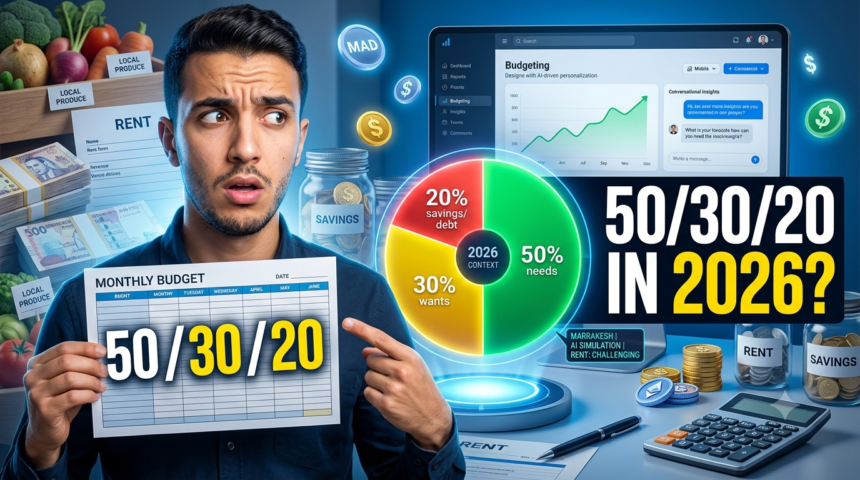
Learn how the 50/30/20 budget rule works, whether it still makes sense in 2026, and how to adapt it to today’s higher living costs.
The 50/30/20 Budget Rule Explained: Does It Still Work in 2026?
Quick answer: The 50/30/20 budget rule remains a useful starting point for managing money in 2026, but it’s no longer realistic for everyone. Rising housing costs, inflation, and higher insurance premiums mean many households need to adjust the percentages to fit their financial reality. The framework still works—it just isn’t one-size-fits-all.
If you’ve searched for budgeting advice, you’ve probably come across the 50/30/20 rule. It’s one of the most widely recommended budgeting methods because it’s simple to understand and doesn’t require tracking every dollar you spend.
The basic idea is straightforward:
- 50% of your after-tax income goes toward needs.
- 30% goes toward wants.
- 20% goes toward saving, investing, or paying down debt.
When the rule was popularized, it offered an easy framework for balancing everyday spending with long-term financial goals. But in 2026, many people are asking whether those percentages still make sense as housing, groceries, healthcare, and insurance continue to consume larger portions of household budgets.
The short answer? For many people, the rule still provides a solid foundation—but it often needs some flexibility.
What Is the 50/30/20 Budget Rule?
The 50/30/20 rule divides your after-tax income into three categories rather than dozens of individual expense lines.
| Category | Percentage | Examples |
|---|---|---|
| Needs | 50% | Housing, utilities, groceries, transportation, insurance, minimum debt payments |
| Wants | 30% | Dining out, streaming services, vacations, hobbies, entertainment |
| Savings & Debt | 20% | Emergency fund, retirement investing, extra loan payments, investing |
The goal isn’t perfection. It’s creating a simple system that encourages spending intentionally while consistently saving for the future.
Understanding “Needs”
Needs are expenses that are difficult—or impossible—to avoid.
These generally include:
- Rent or mortgage payments
- Property taxes (if applicable)
- Basic groceries
- Utility bills
- Health insurance
- Auto insurance
- Transportation to work
- Prescription medications
- Minimum credit card or loan payments
One common mistake is labeling every recurring expense as a necessity.
For example, internet service may be essential for many remote workers, but multiple premium streaming subscriptions probably aren’t.
Being honest about the difference between needs and wants is one of the most valuable parts of this budgeting method.
What Counts as “Wants”?
Wants are purchases that improve your lifestyle but aren’t essential for meeting basic living needs.
Examples include:
- Restaurant meals
- Concert tickets
- Gym memberships
- Premium streaming services
- New electronics
- Vacations
- Designer clothing
- Subscription boxes
That doesn’t mean you should eliminate these expenses entirely.
A sustainable budget usually includes room to enjoy life. The goal is to spend intentionally rather than impulsively.
Why the 20% Savings Category Matters
The final portion of the budget focuses on building long-term financial security.
This category may include:
- Emergency savings
- Retirement contributions
- Roth IRA or Traditional IRA investments
- Brokerage account investments
- Extra mortgage payments
- Additional student loan payments
- Paying more than the minimum on credit cards
For younger workers, consistently investing even modest amounts can benefit from decades of compound growth.
For people nearing retirement, this category may shift toward preserving wealth and reducing debt.
Does the 50/30/20 Rule Still Work in 2026?
The biggest challenge today isn’t the idea behind the rule—it’s the math.
Many households now spend well over 50% of their after-tax income on necessities alone.
Common reasons include:
- Higher housing costs
- Rising insurance premiums
- Increased grocery prices
- Childcare expenses
- Student loan payments
- Medical costs
For someone living in an expensive city, allocating only half of their income to necessities may simply not be realistic.
That doesn’t mean budgeting has failed. It means the percentages may need to reflect your circumstances.
A Flexible Version That Fits Modern Budgets
Rather than forcing yourself into fixed percentages, consider using the rule as a guideline.
For example:
| Budget Style | Needs | Wants | Savings |
|---|---|---|---|
| Classic | 50% | 30% | 20% |
| Higher Cost of Living | 60% | 20% | 20% |
| Aggressive Debt Payoff | 55% | 15% | 30% |
| Early Career | 55% | 25% | 20% |
The exact percentages matter less than consistently balancing spending with saving.
Benefits of the 50/30/20 Rule
It’s Easy to Follow
Unlike detailed budgeting systems that require tracking dozens of spending categories, this method focuses on three broad groups.
That simplicity makes it easier for many people to stick with over the long term.
It Encourages Saving
Many households save only what’s left over after spending.
The 50/30/20 approach flips that mindset by treating savings as a planned expense rather than an afterthought.
It Helps Identify Spending Problems
If your wants regularly exceed 30%, you may discover subscriptions, dining, or impulse purchases that are quietly draining your budget.
Likewise, if your needs consume 70% or more of your income, it may highlight areas where larger financial changes—such as refinancing debt, reducing housing costs, or increasing income—could have the biggest impact.
Situations Where the Rule May Not Fit
The 50/30/20 budget isn’t ideal for everyone.
You may need a different approach if you:
- Live in a high-cost city
- Have irregular freelance income
- Are aggressively paying off debt
- Recently experienced job loss
- Are saving for a home down payment
- Support multiple dependents
In these situations, the percentages should serve as a guide rather than a strict rule.
Tips for Making the Rule Work
If you’d like to try the 50/30/20 approach, start with these steps:
- Calculate your monthly after-tax income.
- Review your last two or three months of spending.
- Categorize each expense as a need, want, or savings/debt.
- Compare your current percentages with the guideline.
- Adjust gradually instead of trying to change everything at once.
Even small improvements—such as increasing your savings rate by a few percentage points—can make a meaningful difference over time.
Term Life Insurance vs Whole Life: Which Policy Fits You?
Is the 50/30/20 Rule Right for You?
The strength of the 50/30/20 rule has never been its exact percentages. Its real value is encouraging balance.
If your current budget allows you to cover essential expenses, enjoy some discretionary spending, and consistently save for future goals, you’re already following the spirit of the rule—even if your numbers aren’t exactly 50, 30, and 20.
Personal finance isn’t about finding the perfect formula. It’s about creating a system you can maintain through changing incomes, rising costs, and unexpected expenses.
For many households in 2026, adapting the framework is more practical than abandoning it.
Disclaimer: This article is for educational purposes only and should not be considered personalized financial advice. Your ideal budget depends on your income, goals, debt, and cost of living.
Frequently Asked Questions
Is the 50/30/20 budget rule still relevant in 2026?
Yes. The framework remains useful, but many households adjust the percentages to reflect higher living costs and personal financial priorities.
Is rent included in the 50% needs category?
Yes. Rent or mortgage payments are generally considered essential expenses and belong in the needs category.
What if my necessities are more than 50% of my income?
That’s increasingly common. Consider adjusting the percentages temporarily while looking for opportunities to reduce expenses, increase income, or improve your financial flexibility over time.
Should debt payments count toward the 20% savings category?
Minimum required debt payments are typically considered needs. Extra payments beyond the minimum usually fit within the savings and debt repayment category.
Is the 50/30/20 rule better than zero-based budgeting?
Neither method is universally better. The 50/30/20 rule emphasizes simplicity, while zero-based budgeting offers greater detail and control. The best choice depends on your financial goals and how closely you want to track your spending.